
“Design thinking relies on the context of data and information to create effective solutions. We take a bigger risk when we ignore or do not understand context.”

Media Fails Our Understanding of Context
A Facebook or Instagram
This shortage of information is endemic in the news coverage that we receive from online and digital channels. Click-through rates and eyeball numbers make the true purpose of the information secondary. Click-bait headlines entice us with headlines that connect to our emotions and biases. What lies next
What’s the Story Behind Context?
We learn about the world through stories and our experiences. Our memories and values help us make decisions. And context—the connective tissue of our world—is the understanding of the relationships between the elements of our lives and environment. When connected, these elements become the knowledge base that can define our information, decisions or strategy. Theater improv does a game called the “three line scene.” The actor is given a name and an observation, a location and details of a scene. These three lines create the context of the scene and the actor’s experiences and creativity evolves the storyline from there. Without the context, the actor and the audience do not have a storyline to build on.
Human behaviors rely on the understanding of the storyline or narrative. Understanding context is vital to our understanding of the landscape and environment around our decision-making process. We are programmed to follow our instincts and biases, but without the proper information and dialogue, we are blind to the unknown and will make decisions and choices based on assumptions. This can create insecurity, uncertainty and can close off discussions, opportunity and potential innovation. Context gives our information meaning and relevancy. Without understanding context, we might as well not have any information at all.
Design Thinking and Context
The term “contextual intelligence,” which has been around since the mid-1980s, is the understanding of our own knowledge and the ability to shift or adapt the information towards an adjacent or different experience or environment. This is a vital part of design thinking. In order to fully understand how a product or value proposition of an organization connects to the needs of the user, we must look at the context of the information and the scenario. From that
Design thinking solutions reside at the center of a comprehensive thought process. Context connects the data and information points that are specific to a subject or product within these categories. By connecting these pieces of information, we can have a stronger understanding of how something fits within the larger landscape or environment. This is what creates the storyline. Once this information is gathered, you can connect it with your framework or brief to create a more intricately detailed picture of your goals and directions.
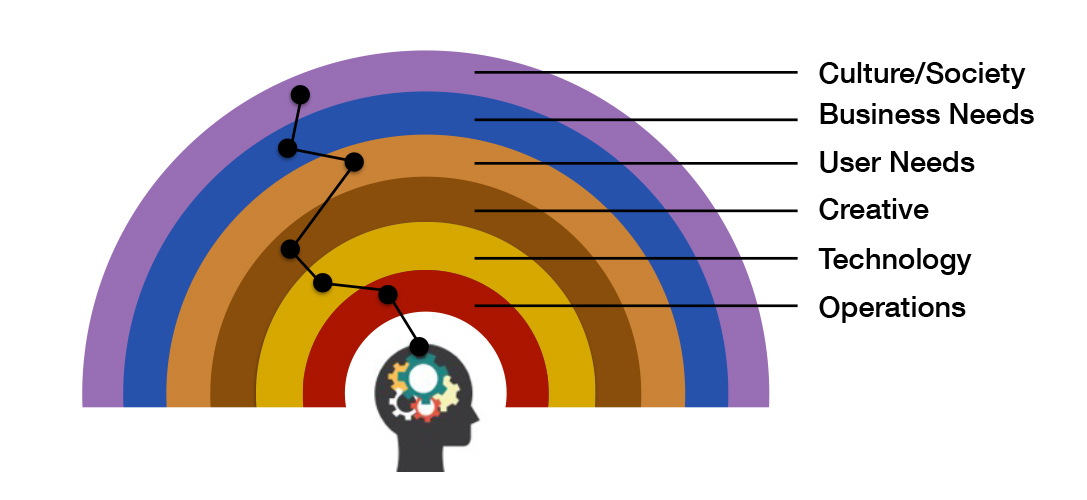
The collection and accessibility of data is an important part of design thinking. To properly design a solution, a design thinker must fully understand the data and the information. This will allow them to design a comprehensive solution. Design thinking, creativity and context bridge the gap between data and information with the implementation and operations of a solution. A pile of Lego bricks can still be made into a house, but with creativity and context, a story can be built around that Lego house.
As Humans, We Need the Full Story
Our roles in this world are defined by the information that we receive and seek out. Personal goals and organizational strategy are all shaped by this understanding and knowledge. These days, there are endless amounts of information channels, but it’s the responsibility of the individual to spend the time and effort to seek out the relevant information in order to best understand the context. Design thinking relies on the context of data and information to create effective solutions. When you don’t know the facts, it’s human nature to fill in the blanks, but design-driven solutions require information so they can be properly shaped and connected to user needs.
Building and executing strategy is an uncertain process. A strong understanding of the context in which the strategy will be implemented removes some of the uncertainty, which can lead to a more focused execution. We take a bigger risk when we ignore or do not understand context. Those executing the strategy need to fully understand the strategy. It does not matter how strong the strategy is, it will fail if the execution is poor because of a misunderstanding or poor decision-making.
A Call to Action
Scientist and engineers are currently working on the next generation of artificial intelligence. They are developing these machines to understand the relationships between the different parts of their environment. This way the AI can understand the context of the situation. As technology and data continue to envelop our lives, it is becoming more and more important that we understand the context of the idea, storyline, needs or position. Not only is our business landscape rapidly changing, but our daily lives are swept up into the turmoil as well. How we receive and utilize technology to communicate and receive information is rapidly changing and evolving. A solid understanding of context will give you a stronger platform in order to use of technology, data, information and communication channels to it’s fullest extent. More importantly, it will also help you understand human behaviors and the decision-making processes. We have to be careful not to lose our humanity to technology. Design thinking develops solutions that are focused on human needs, whether they are product or business related. These are the stories that we need to build and connect to. Just like the improv actors, we need to know the context of the situation in order to understand, share and tell our story.